Golf
Why the ground beneath the ball decides more of a shot than the swing does
Amateur analysis of golf concentrates almost entirely on the motion of the club, yet the interaction between clubface, ball and the surface underneath determines most of what happens after impact.
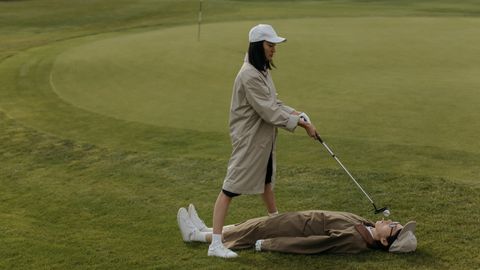
What sits between the clubface and the ball
A clean strike from a closely mown surface allows the grooves on the clubface to contact the ball directly and impart the spin the club was designed to produce. Any grass caught between the two acts as a lubricant, reducing friction at impact and therefore reducing the backspin the shot carries. Less backspin means less aerodynamic lift, a lower flight and a ball that runs considerably further after landing than the player expected.
This is the mechanism behind the shot that flies over a green from an apparently comfortable distance, and it originates in the lie rather than the swing. The player did nothing differently; the surface changed the physics of the collision before the club ever arrived.
Why rough is not simply harder
Longer grass does not merely make a shot more difficult, it makes the outcome less predictable, which is a different and more serious problem. The amount of grass that intervenes depends on how the ball is sitting, and a ball perched on top of the rough behaves nothing like one that has settled to the bottom. Two shots from adjacent positions in the same rough can therefore travel substantially different distances despite identical clubs and identical swings.
Grass also grabs the hosel and closes the clubface through impact, which turns a distance problem into a directional one as well. Skilled players read the lie before choosing the club, because the club choice is downstream of what the surface will permit.
How firmness changes the approach
Firm ground allows a club to strike the ball and then skid rather than dig, which encourages a shallower approach and a cleaner contact. Soft ground lets the club enter the turf, so a player must either accept a steeper strike or move the ball position to compensate. The same swing therefore produces different results on the same hole depending on how much moisture the ground is holding that morning.
This is why practice sessions on a mat teach very little about the part of the shot that actually varies from day to day. Turf interaction is a skill in itself, and it is largely invisible in any footage that shows only the club and the player.
Slope as a hidden variable
A ball resting above or below a player's feet changes the effective lie angle of the club, which alters the direction the face points at impact. Uphill and downhill lies change the effective loft, so the same club delivers a higher or lower flight and a different carry distance. These effects combine rather than cancel, and a downhill lie on a sidehill slope produces a shot shape most players never practise deliberately.
Course architects use this knowledge by placing hazards where a missed shot will leave an awkward stance rather than merely a long one. A bunker in an obvious place is a modest penalty; a sloping lie in an unremarkable place is a far larger one.
Why the short game magnifies everything
Around a green, the ball is travelling slowly and spending most of its journey on the ground, so surface condition dominates the outcome. A chip landing on firm ground releases and runs, while the same shot on soft ground checks and stops within a short distance. Grain direction in the grass alters friction depending on which way the blades are lying relative to the intended path of the ball.
This is the part of the game where local knowledge is worth the most, because none of it can be judged from a yardage. Players who travel between regions with different grass types often struggle precisely here rather than with any part of the full swing.
- Grass between clubface and ball removes spin before it removes distance
- A flier is a lie problem, not a strike problem
- Firmness changes the angle the club can approach from
Also by Nadia Petrova
- How qualification formats shape the development of smaller footballing nationsFIFA
- How surface pace is measured, and why players feel it before the data showsTennis
- Why the runway approach is the part of a jump that most often failsAthletics
- How repeated head impact is studied differently from a single knockoutUFC/MMA


